Thirty-Six Columns, Zero Coincidences
The 36 Doric columns surrounding the memorial stand 44 feet tall with bases stretching more than 7 feet across. They dominate the exterior. Their number isn’t decoration — it’s arithmetic. Bacon chose 36 columns to match the 36 states in the Union on April 14, 1865, the night Lincoln was shot.
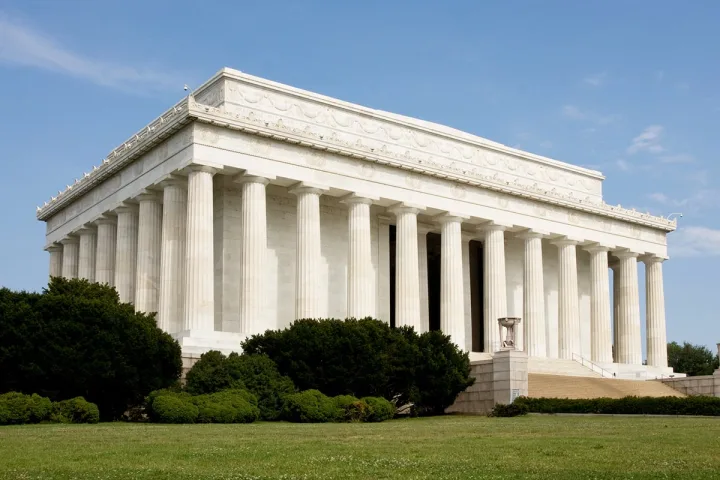
By the time the building was finished in 1922, the country had grown to 48 states. Bacon had already accounted for that: the names of all 48 contiguous states are inscribed along the top of the memorial above the columns. Alaska and Hawaii, which didn’t achieve statehood until 1959, got their own bronze plaque added to the plaza in 1976. Late to the wall, but not forgotten.
The Ground Wasn’t Always Ground
The Lincoln Memorial doesn’t just sit on historic land. It sits on land that didn’t exist 150 years ago. The site was called Kidwell Flats — a boggy, mosquito-ridden stretch of the Potomac River. When the original National Mall plans were drawn up in 1791, they stopped at the Washington Monument, right at the river’s natural edge. Everything to the west was swamp.
The U.S. Army Corps of Engineers spent the 1880s and ’90s dredging the Potomac and piling soil westward, manufacturing solid ground out of marsh. Today that reclaimed land holds the Lincoln Memorial, the World War II Memorial, the Martin Luther King Jr. Memorial, and the Jefferson Memorial. The Reflecting Pool was also built on the same dredged soil — and paid for it. Without pilings beneath it, the pool sank roughly a foot into the soft ground below, cracking and leaking until it required 30 million gallons of water a year just to stay full. A complete overhaul in 2012 finally fixed the problem and installed a sustainable water system.
A Hundred Years of Empty Space
NPS rangers at the memorial get the same question constantly: what’s underneath it? For a century, the honest answer was almost nothing. Beneath the structure sits a cavernous undercroft — 43,800 square feet of massive concrete columns and builders’ graffiti scrawled into the walls by the original construction crew. No buried president. Lincoln was laid to rest in Springfield, Illinois. Just echoing space nobody ever saw.
That changes in July 2026. An immersive museum is set to open inside the undercroft, converting 15,000 square feet of that underground cavern into public exhibit space. The exhibits will cover the memorial’s construction, its history, and its role in American civil rights — including the stage it provided for Martin Luther King Jr.’s “I Have a Dream” speech in 1963. Floor-to-ceiling glass walls will let visitors look beyond the exhibits into the raw, undeveloped concrete foundations, a rare view of the structural bones beneath one of the country’s most recognized landmarks.