The Couple Who Actually Built One
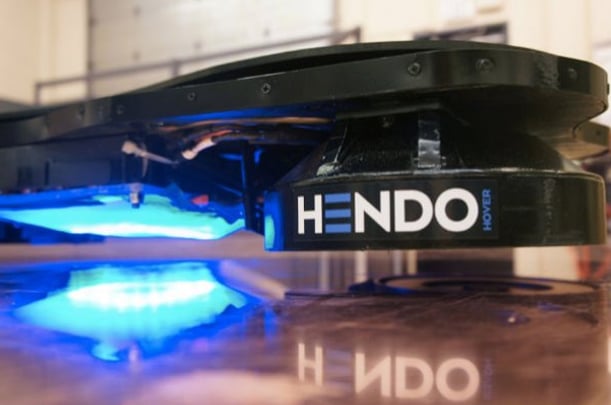
Jill and Greg Henderson, founders of a California-based technology startup called Arx Pax, became the first people to build a functional hoverboard that works through magnetic repulsion alone. Their device, called the Hendo Hoverboard, is not a concept rendering or a crowdfunded promise — it physically lifts a rider off the ground. The Hendersons came from backgrounds in construction and design rather than academic physics, and their approach to the problem was pragmatic rather than theoretical. Greg Henderson has described the hoverboard as a proof of concept, a way to demonstrate a broader magnetic technology platform in a form that is immediately understandable to anyone. The device represents years of iterative work figuring out how to make magnetic levitation controllable enough for a person to actually stand on.
How the Hendo Hoverboard Actually Levitates
The Hendo Hoverboard uses four disc-shaped motors mounted beneath the board. Each motor generates a rotating magnetic field that induces opposing magnetic currents in a conductive surface below, pushing the board upward through repulsion. Arx Pax calls this system Magnetic Field Architecture, or MFA — their specific approach to directing and shaping magnetic fields. The key difference from simple magnet-to-magnet repulsion is that MFA generates a field that only reacts to specific conductive materials, particularly copper and aluminum. That means the hoverboard does not simply float over any surface — it requires a specially prepared conducting floor to work. In the current setup, the board lifts a rider roughly one inch above the surface, which sounds modest but represents a genuine engineering achievement given how difficult controlled levitation actually is.
Why the Surface Requirement Is a Feature, Not a Flaw
The requirement for a conductive surface is the most significant practical limitation of the Hendo Hoverboard in its current form. The board cannot float over water, pavement, grass, wood floors, or most real-world surfaces. It needs a sheet of copper or aluminum to react against — which is why Arx Pax discussed building dedicated hoverboard parks at launch. This is not a design flaw so much as a physics constraint built into the MFA system. The same limitation applies to Maglev trains, which travel on specially engineered tracks and cannot run on any existing railway line. What the Hendersons demonstrated is that the levitation itself can be stable and rider-supporting — solving the surface compatibility problem is a separate engineering challenge they were already working on at the time of launch.