What Riding It Actually Feels Like
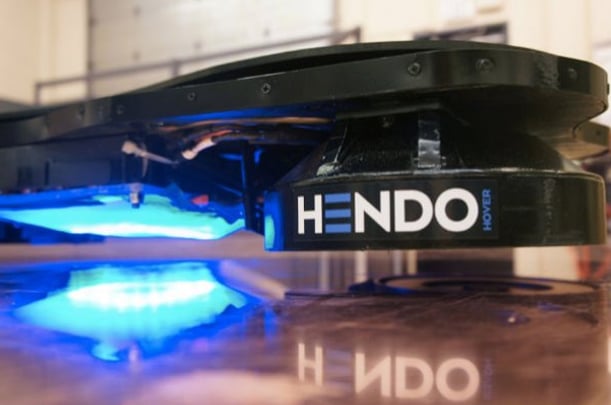
Sean Buckley, a reporter for Engadget, was among the first outside journalists to ride the Hendo Hoverboard and described the sensation in concrete terms. The board maintained a steady altitude of roughly one inch under his 200-pound frame without visible mechanical strain. There was subtle wobble — the board shifted slightly underfoot as the magnetic field responded dynamically to his weight distribution — but it did not tip, slide, or require constant physical correction to stay level. That wobble is actually meaningful: it indicates the magnetic suspension is doing active work, constantly adjusting to keep the board stable. Arx Pax confirmed that the prototype could support up to 300 pounds comfortably, with future iterations being engineered toward a 500-pound capacity. The experience is closer to standing on a raft on calm water than riding a skateboard.
The Kickstarter That Brought It Public
Arx Pax funded Hendo Hoverboard development partly through a Kickstarter campaign, using the device as a high-visibility demonstration of their underlying technology platform. Early backers who wanted an actual working hoverboard could reserve one for $10,000 — a price that reflects its status as a hand-assembled prototype rather than a consumer product. For people more interested in the engineering than the ride, Arx Pax also offered DIY developer kits for $300, containing the core magnetic drive components so hobbyists and engineers could experiment with MFA technology in their own setups. The tiered approach allowed the company to raise funds, generate awareness, and put the technology directly in front of engineers who might find novel applications for it, without positioning the hoverboard itself as a transportation product.
Buzz Aldrin Took It for a Spin
Among the early test riders who stepped onto the Hendo Hoverboard was Buzz Aldrin, the Apollo 11 astronaut who walked on the Moon in 1969. Aldrin’s appearance connected two very different chapters in the history of human transportation — a man who traveled farther from Earth than almost any other person, standing on a board floating one inch above a copper floor. It was a deliberate piece of public communication on Arx Pax’s part, a reminder that technologies which seem impractical at first can reach maturity within a human lifetime. Aldrin has spent decades advocating for ambitious engineering projects, and his willingness to ride the prototype lent a specific kind of credibility to the demonstration — not scientific validation, but a signal that the technology was real enough to stand on.