The Doctor Who Thought Vegetables Were Dangerous
James H. Salisbury wasn’t a chef. He was a physician with strong opinions about digestion and a gift for naming things after himself.
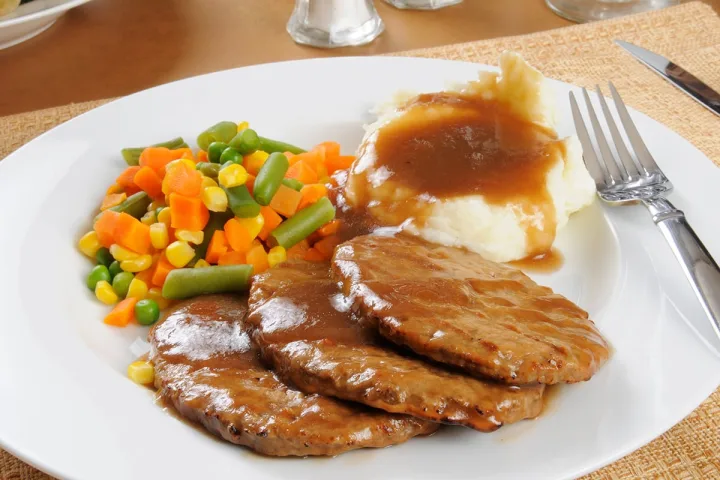
Salisbury was an early believer in germ theory, but his version of the science went sideways in places. He believed vegetables released toxins into the digestive system. His solution was beef. Ground beef, shaped into a patty, soaked in gravy, served as medicine. He first described the dish in his 1888 book as “muscle pulp of beef”—a phrase that somehow failed to catch on. The name Salisbury steak did.
He formalized the recipe in 1897 and died in 1905. The dish outlived his questionable nutritional theories by about a hundred years, graduating from doctor’s orders to frozen TV dinner staple.
A Painting That Became a Plate
In 1950, a Venetian restaurateur named Giuseppe Cipriani faced a specific problem: one of his regular customers at Harry’s Bar in Venice had been told by her doctor to avoid cooked meat entirely. Cipriani didn’t want to lose her business.
He invented a dish of thinly sliced raw beef, draped over a plate and finished with Parmesan, lemon, and olive oil. For the name, he looked to an exhibition at the Doge’s Palace, where the works of Italian Renaissance painter Vittore Carpaccio were on display. Carpaccio was known for his deep reds and stark whites. The raw beef against white sauce matched the palette almost exactly.
The dish became one of the most copied starters in fine dining. Raw tuna carpaccio, beet carpaccio, zucchini carpaccio—the word now applies to almost anything sliced thin and served cold. Vittore Carpaccio painted altarpieces in the 1490s. He probably didn’t see that coming.
The Minister Who Wanted to Kill Your Appetite
Sylvester Graham was a 19th-century Presbyterian minister with a passionate distrust of white flour, red meat, and anything that tasted too good. He called himself a dietary reformer. His critics had other words for him.
Graham believed that rich, highly seasoned foods inflamed the body’s baser impulses. His answer was a coarse whole-wheat flour he developed himself, which he used to produce a cracker in 1829. The original graham cracker was thin, savory, and designed less as a snack than as a tool for moral discipline.
Other bakers saw a market opportunity. A baker named J. Thompson Gill created the first sweet version in 1881, and Nabisco eventually scaled it into a mass-market product. Today’s graham cracker—sweet, cinnamon-tinged, the foundation of s’mores everywhere—would have horrified the man whose name it carries.