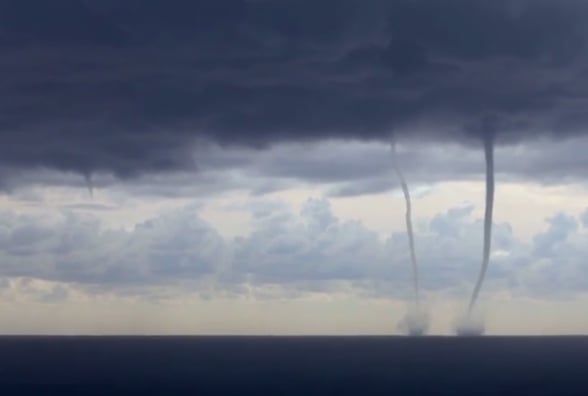
Greek Islands and Australian Waters Are Also Hotspots
Beyond Florida, two other regions stand out as consistent waterspout territory. The Greek islands sit in the eastern Mediterranean, where warm sea temperatures and frequent late-summer convective storms create reliable waterspout conditions from late spring through autumn. The Aegean and Ionian seas in particular see enough waterspout activity that local fishermen and sailors factor them into seasonal weather awareness. Off the east coast of Australia, the combination of warm Coral Sea waters and the active storm patterns that roll in from the Pacific creates another prolific zone. The Whitsundays and the waters north toward Queensland see regular waterspout activity, particularly during the Australian summer, when the tropical air mass sits over warm coastal waters for months at a stretch.
What Separates a Waterspout From a Tornado on Land
The core physics of a tornadic waterspout and a land tornado are nearly identical, but the surface they interact with changes several aspects of the experience. Land tornadoes pick up debris, soil, and structural material as they move, which adds mass to the rotating column and darkens its appearance. Waterspouts pull in water and mist, which gives them a lighter, more translucent look while still maintaining the rotating structure underneath. A waterspout that crosses from open water onto land effectively becomes a tornado at that point, complete with the debris-lofting behavior. Mariners are advised to treat any tornadic waterspout with the same level of caution as a land tornado, giving it wide berth rather than attempting to observe it from close range.
Why the Footage Keeps Surprising People
Video and photographs of waterspouts consistently generate strong reactions from people seeing them for the first time, and the reason is straightforward: nothing in ordinary daily experience prepares the eye for the sight of a rotating atmospheric column visibly bridging the gap between ocean and cloud. The sense of scale is difficult to process. The column appears thin from a distance but can be hundreds of feet in diameter at its base, and the rotation, while visible in good footage, moves faster than it appears. Fair-weather waterspouts in particular look almost gentle from a safe distance, which is part of what makes them so photogenic. They are powerful enough to be visually dramatic but usually not violent enough to pose immediate danger to observers on shore, creating a rare situation where nature is putting on a genuine spectacle within relatively safe viewing range.