The Flightless Parrot Coming Back From the Dead
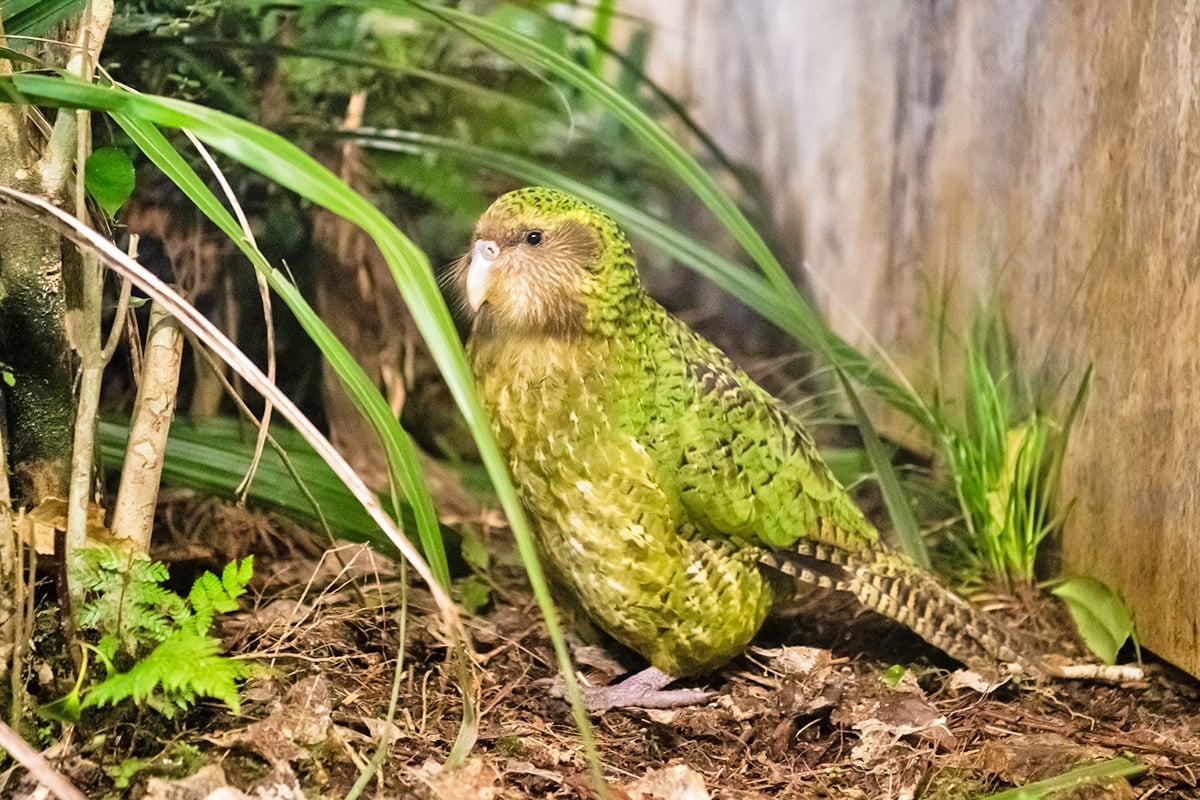
The kākāpō is immediately absurd, in the best possible way. It’s a large, bright-green, nocturnal parrot that cannot fly, has the face of an owl, and walks with a pronounced waddle. It was once common across New Zealand. Then humans arrived. First Māori settlers in the 13th century, who hunted it and brought the Polynesian rat. Then European colonizers who introduced cats and cleared forests. By the mid-1990s, fewer than 60 kākāpōs were left on Earth.
What happened next is one of conservation’s more remarkable stories. Māori guardians and government scientists relocated the remaining birds to predator-free offshore islands and managed their breeding, health, and genetics for decades. The population has climbed to around 235 birds. In 2023, kākāpōs were returned to a mainland sanctuary for the first time in roughly 50 years.
Then 2026 happened. More than 100 chicks hatched, the most in over three decades. The species is still critically endangered. But 100 chicks is 100 chicks.
Madagascar’s Most Misunderstood Lemur
The aye-aye looks like a creature assembled from spare parts. House-cat sized, with enormous round eyes, radar-dish ears, shaggy black fur, and a skeletal middle finger longer than its own hand. That finger isn’t just strange to look at. It’s a precision instrument. The aye-aye taps rapidly on tree bark, listens for hollow spaces beneath the surface, then drills in and extracts insects with that elongated digit. Percussive foraging, scientists call it. Only a handful of species on Earth do it.
The aye-aye’s unusual appearance has made life harder for it. In parts of Madagascar, local tradition considers it a bad omen, and it’s killed on sight. The larger threat is deforestation. Aye-ayes are seldom seen, but the distinctive drill holes they leave in tree bark give them away. Their total population remains unknown. What is clear is that their forest keeps shrinking.
The Four-Eyed Antelope Nobody Talks About
The hirola lives only along a narrow strip of the Kenya-Somalia border, one of the least-visited corners of the world. It’s graceful, with long curved horns that arch upward like a harp frame, but the feature that stays with you is its eyes. Pale, goggle-like rings surround them, which is how the hirola earned its nickname: the four-eyed antelope.
In the 1970s, thousands roamed the region. Today, around 500 survive. Viral disease outbreaks hit the population hard in the 1980s. Then the grasslands changed, with shrubs and trees creeping into the open savanna hirolas depend on. More cover brought more predators: lions, cheetahs, and even eagles taking the young.
Conservationists have turned to an unexpected strategy: protect the elephants and rhinos sharing the hirola’s habitat. Those animals graze heavily, trample vegetation, and keep the land open. It’s an elegant fix, borrowed from the ecosystem itself. Whether it comes in time is still unresolved.