
The Pope Who Couldn’t Do Math Either
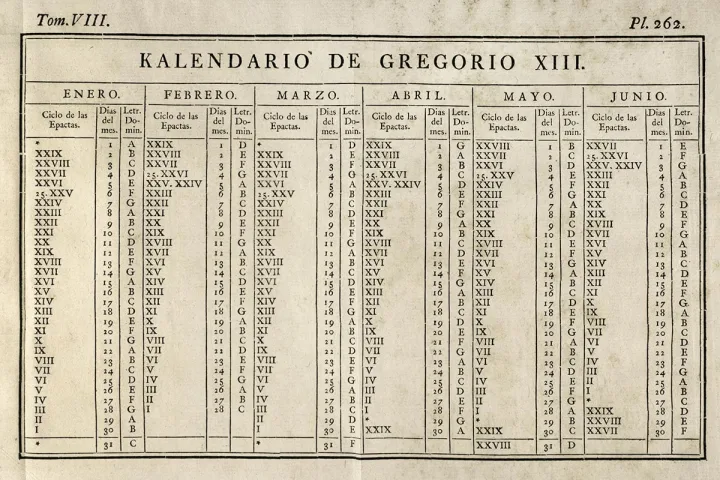
The Julian calendar ran 11 minutes too long each year. That sounds trivial. Over twelve centuries, it wasn’t. By the 1500s, the calendar had drifted a full ten days from where it had been when the Council of Nicaea fixed the date of Easter in 325 CE. Easter was sliding away from the spring equinox, and Pope Gregory XIII found this intolerable.
Gregory XIII, like Caesar before him, was not the man to solve it himself. He turned the problem over to Italian mathematician Aloysius Lilius and German mathematician Christopher Clavius, who devised a clean rule: any year divisible by 100 is not a leap year, unless it’s also divisible by 400. The year 2000 was a leap year. The years 1700, 1800, and 1900 were not. Neither will 2100 be. With that single tweak, the Gregorian calendar became accurate to within one day every 3,236 years.
Still Not Perfect. Never Will Be.
The Gregorian calendar averages 365.2425 days per year. Earth’s actual orbit takes 365.24219. That gap means the calendar still drifts, just slowly. Somewhere around the year 4818, whoever is keeping time on this planet will face yet another reckoning.
In the past 50 years, scientists have added 27 “leap seconds” to atomic clocks, because Earth’s rotation isn’t perfectly steady. Earthquakes, volcanic eruptions, tidal forces, even large-scale wind patterns can nudge the length of a day. When those oddities pile up, the clock reads 23:59:60 before flipping to midnight. In 2015, global stock markets halted trading when one of these seconds was inserted on June 30. The scientific community has agreed to phase out the practice entirely by 2035.
Born on the Rarest Day
The odds of landing on February 29 are 1 in 1,461. About five million people have managed it. Known as leapers, leaplings, or leapsters, they typically pick either February 28 or March 1 to celebrate in non-leap years, which means they’re never quite sure which day belongs to them.
The most striking case is the Keogh family, Irish-British by origin. Grandfather Peter Anthony was born on February 29, 1940. His son Peter arrived on February 29, 1964. Granddaughter Bethany was born on February 29, 1996. Three generations, one date. Ireland regards leap birthdays as a curiosity worth celebrating. Scotland, considerably less charmed, has traditionally held that anyone born on leap day “will live a life of untold suffering.”
Proposals, Postcards, and One Texas Town
Ireland also gave the world “Bachelor’s Day,” the tradition allowing women to propose marriage on February 29. The custom spread, and in the U.S. it twisted into something less charming: greeting cards and advertising campaigns depicting aggressive, lovesick women using their 24-hour window to corner reluctant bachelors. It faded as marriages became more equal through the 1970s.
The better tradition belongs to Anthony, Texas, which calls itself the Leap Year Capital of the World. In 1988, two neighbors named Mary Ann Brown and Birdie Lewis, both born on February 29, pitched a festival idea to the local Chamber of Commerce. It stuck. Every four years, leaplings from around the world gather for a three-day event: an exclusive party for leap-day birthdays on February 29, then two days of music and food at Anthony Municipal Park open to everyone. Of all the ways humans have tried to reconcile their calendars with an indifferent solar system, a west Texas block party may be the most honest response.