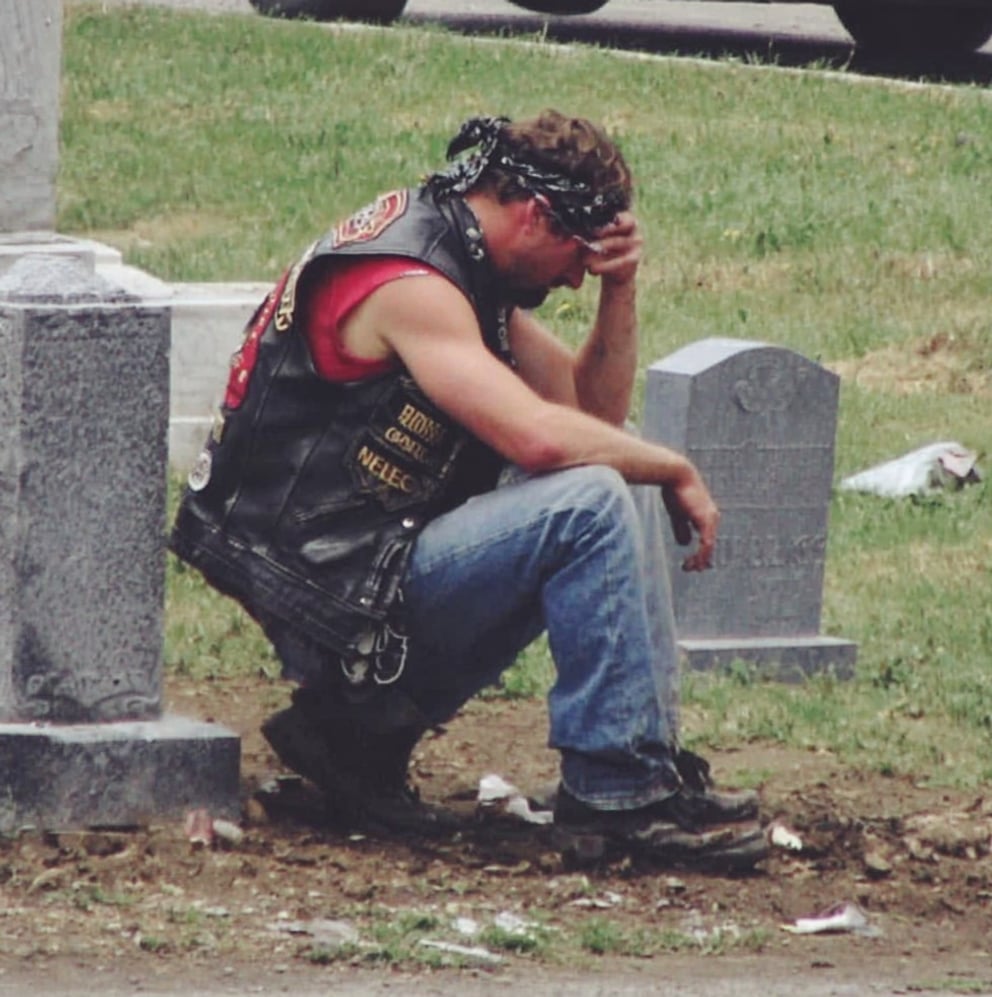
For six months, I watched him from my car. Every Saturday at 2 PM, same as clockwork, he’d roll into the cemetery on a Harley, walk straight to Sarah’s headstone, and stay for exactly one hour. No flowers. No obvious prayer. Just a massive, tattooed man sitting cross-legged on the ground with his head bowed, his hand resting on the stone before he left.
I told myself the first time he had the wrong grave. Cemeteries are big. People get confused. But he came back the next week, and the week after that, and I went from confused to furious. My wife had been a pediatric nurse who drove a minivan and treated a second espresso shot as her wildest indulgence. There was no version of her life that connected to a six-foot-four biker with a beard down to his chest. Yet here he was, grieving her like he’d lost something irreplaceable. I could see his shoulders shaking from fifty yards away.
After three months I got out of the car. He heard my footsteps on the gravel but didn’t turn around, just kept his palm flat against her headstone. I told him who I was. My voice came out harder than I meant. He stood slowly, turned to face me, and his eyes were red. He looked like a man who had been crying for years. “I’m sorry,” he said. “I didn’t mean to intrude. I just needed to say thank you.” His name was Mike. He was forty-seven, a mechanic, and he had a daughter named Kaylee who was nine years old when she was diagnosed with leukemia. Treatment had eaten through everything his family owned — their house, their savings, eighty-hour work weeks and two jobs for his wife — and they were still $40,000 short. He was standing in a hospital hallway one afternoon, trying not to fall apart where Kaylee could see him, when a nurse stopped and asked if he was okay. He told her everything. She listened without flinching, didn’t treat him like a stranger to be managed, and when she left she told him: sometimes miracles happen. Don’t give up hope. Two days later the hospital called. An anonymous donor had paid Kaylee’s remaining costs in full.
Kaylee went into remission. Three years later, cancer-free. Mike spent years trying to find out who had saved her, hitting wall after wall with the hospital’s privacy policies, until one day he was going through old paperwork and found a billing reference number. He pushed the billing clerk until she slipped — just a single word, a pronoun, her — and a first name buried in the reference code: Sarah. He tracked down which nurses had worked that day. Three Sarahs. He found mine through social media, recognized her face from that hallway immediately, sent Facebook message after message that sat unread. Then he Googled her name and found her obituary instead.
“The woman who saved my daughter’s life was gone. And I never got to thank her.”
So he came to her grave. We sat on opposite sides of the headstone in the November cold while he told me all of this, and I was crying before he finished because I already knew the part he didn’t. Fifteen years ago Sarah and I had $40,000 set aside for a kitchen renovation. One day it was gone. She told me she’d spent it on something important and wouldn’t say what. We had the worst fight of our marriage. I accused her of recklessness, of freezing me out of a major decision. She looked at me steadily and said: I did what I had to do. You’ll understand someday. I never did. Not until Mike.
He offered to stop coming. Said it was our family’s space and he didn’t want to intrude. I told him no — keep coming, she’d want to know about Kaylee. The following Saturday I brought two lawn chairs. We’ve been sitting together at that grave every week since. Sometimes we talk for hours. Sometimes we don’t say anything. Last month Mike brought Kaylee. She’s sixteen, honor roll, wants to be a doctor, volunteers now at the children’s hospital. She laid flowers on the stone and stood there for a long time. Mike checks on my kids. Helped my son with his car. Showed up with groceries on a day I couldn’t make myself leave the house. His wife sends cookies for my daughter. We are, improbably and permanently, family.
People at the cemetery glance over sometimes — the widower and the biker keeping their weekly vigil. I don’t care what they make of it. Sarah spent twenty years being exactly who she was, quietly and without announcement, and the proof of it is a teenager who’s alive and planning a life in medicine because a nurse she never really knew looked at a desperate stranger and decided that was enough reason to act. I was angry at my wife for years over $40,000. I sat at her grave for a long time after Mike rode away that first day, just talking to her. Telling her I finally understood. Telling her I was sorry it took me so long.