Gem Mining That Teaches as Much as It Entertains
About ten minutes west of Boone, Foggy Mountain Gem Mine offers a hands-on experience rooted in the region’s actual geological history. Gem mining was economically significant in western North Carolina for generations, and rubies, emeralds, and sapphires are genuinely found in the area’s mineral-rich soil. The mine has been run by the same family across multiple generations. Visitors purchase a bucket of gem-bearing material and sift through it at sluice troughs — the process requires no prior knowledge, just patience and attention. Finds can be cut, polished, and set into jewelry on-site. The experience works across a wide age range: children respond to the treasure-hunt element, while educational exhibits on local mining history and geology give adults more to engage with. The connection to regional history keeps it from feeling like a purely manufactured attraction, which is a meaningful distinction in a region where manufactured attractions are easy to find.
Moses H. Cone Memorial Park and Flat Top Manor
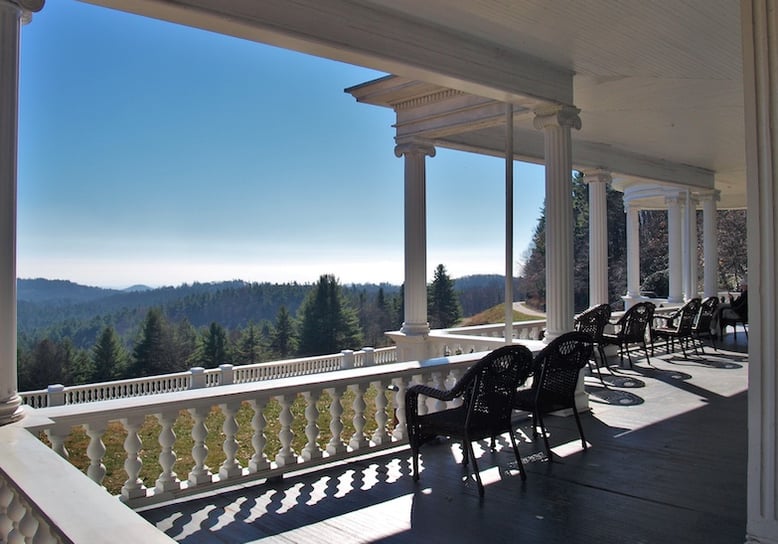
About 20 minutes south of Boone near Blowing Rock, Moses H. Cone Memorial Park preserves the former estate of a textile magnate whose fortune was built on the industrial output of post-Civil War North Carolina. The centerpiece is Flat Top Manor, built in 1901 in Beaux-Arts style. The manor house has multiple decorated rooms open to visitors, with a wide porch offering views across the grounds. The estate grounds are extensive — trails and paths run through flower-filled meadows and mixed woodlands, suitable for hiking, horseback riding, and cycling. The park sits within the Blue Ridge Parkway corridor, which gives it a protected, carefully managed quality. A craft center on the property displays and sells work by local artists year-round. The combination of architectural history, parkway scenery, and active arts programming makes Moses H. Cone Memorial Park a more layered destination than its name suggests to first-time visitors.
Grandfather Mountain Holds the Highest Point in the Blue Ridge
Half an hour southwest of Boone, Grandfather Mountain reaches 1,812 meters — the tallest peak in the entire Blue Ridge range. The state park built around the mountain is one of the most visited in North Carolina, anchored by a single attraction that earns the attention on its own: the Mile High Swinging Bridge. Strung between two of the mountain’s peaks, it is the highest suspension bridge in the United States, and the views from the span extend in every direction across successive ridgelines. Beyond the bridge, the park maintains a network of trails ranging from accessible walks to technical scrambles on exposed ridgeline. Each July, the mountain hosts the Highland Games — a gathering of Scottish clans competing in traditional events and celebrating ancestry that has been part of Appalachian culture since the earliest European settlement of the region. The combination of geology, infrastructure, and cultural programming makes Grandfather Mountain one of the more complete destinations in the High Country.
The Blue Ridge Parkway Explains the Whole Region
Understanding Boone requires understanding the Blue Ridge Parkway, because the town sits directly adjacent to one of the most significant scenic roads in the country. At 755 kilometers long, the parkway runs from Shenandoah National Park in Virginia to Great Smoky Mountains National Park in North Carolina, following the spine of the Blue Ridge range the entire distance. It passes through dense forests, open meadows, and high ridgeline with consistent views in both directions. It is the most visited unit in the entire National Park System — a fact that surprises people who assume that title belongs to Yellowstone or the Grand Canyon. From Boone, the parkway provides access to Blowing Rock, Moses H. Cone Memorial Park, and Grandfather Mountain to the south, and extends north toward Roanoke and the Virginia sections of the range. The road was designed strictly for scenic driving — no commercial vehicles, a 45 mph speed limit enforced throughout — conditions that keep it genuinely pleasant to travel across every season.